

Small Business Restructuring (SBR) provides eligible companies experiencing financial difficulty with a formal process to compromise certain debts while directors remain in control of the business.
For some companies, SBR can provide an alternative to voluntary administration or liquidation. However, strict eligibility and procedural requirements apply, so early professional advice is important.
Key Takeaways
- Eligible companies can remain under director control while developing a restructuring plan.
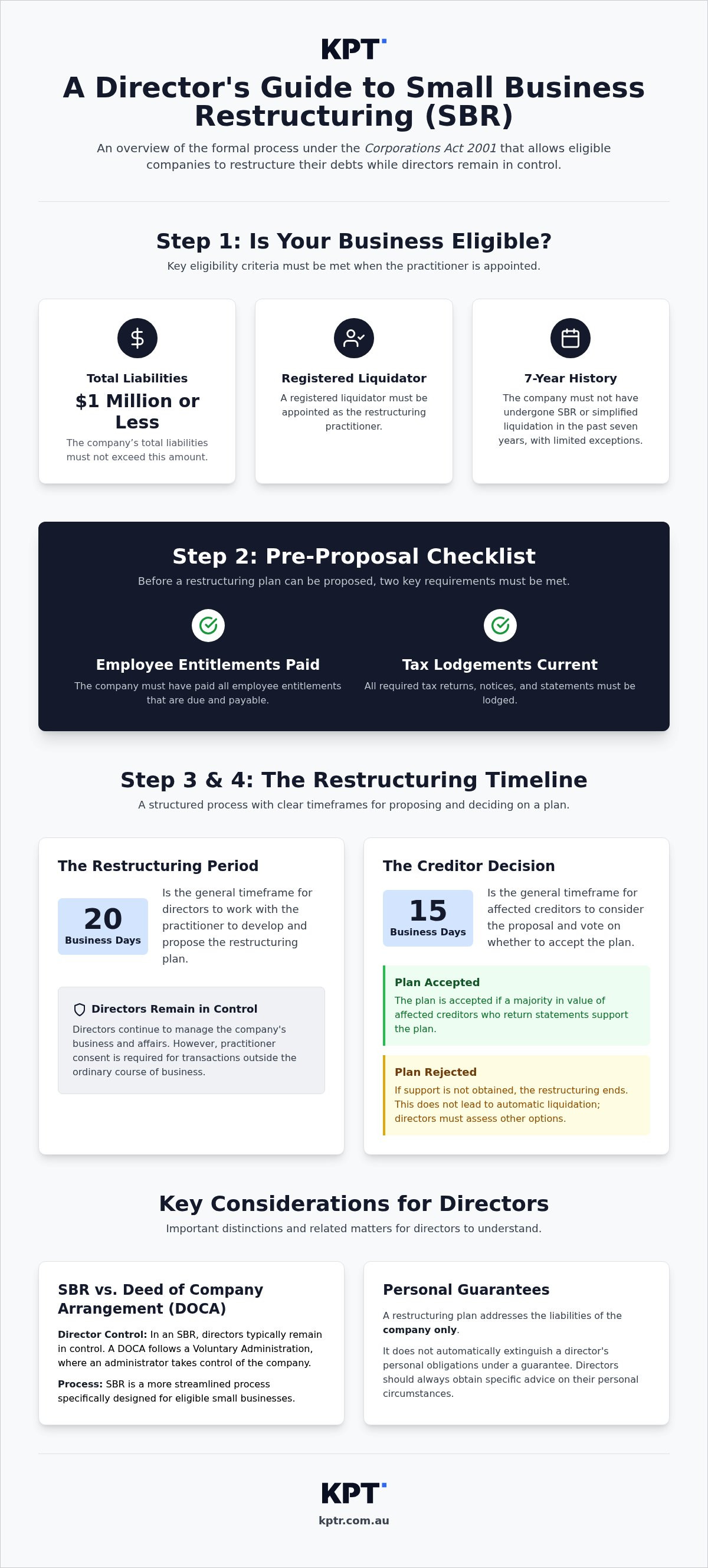
- Total company liabilities must not exceed $1 million when the restructuring practitioner is appointed.
- A registered liquidator must be appointed as the restructuring practitioner.
- The proposal period is generally 20 business days.
- Affected creditors then generally have 15 business days to decide whether to accept the plan.
- Before a plan can be proposed, certain employee entitlement and tax lodgement requirements must be satisfied.
Table of Contents
- What is Small Business Restructuring?
- Who is eligible?
- Employee entitlements and tax lodgements
- What happens during the restructuring period?
- How do creditors approve the plan?
- What happens if the plan is accepted?
- Do directors remain in control?
- What happens if creditors reject the plan?
- Frequently Asked Questions
What is Small Business Restructuring?
Small Business Restructuring is a formal process under the Corporations Act 2001 designed for eligible companies experiencing financial difficulty.
Unlike voluntary administration, directors generally remain in control of the company while working with a restructuring practitioner to develop a proposal for creditors.
The restructuring practitioner must be a registered liquidator and has an independent role in reviewing the company’s financial position and the proposed restructuring plan.
Who is eligible?
To enter restructuring, the company must meet specific eligibility criteria when the restructuring practitioner is appointed.
Key requirements include:
• the company’s total liabilities must not exceed $1 million
• the company must not have undergone restructuring or simplified liquidation within the previous seven years, subject to limited exceptions
• restrictions can also apply where a current or recent director has been a director of another company that underwent restructuring or simplified liquidation within that period.
Eligibility should be assessed carefully before commencing the process.
Employee entitlements and tax lodgements
Before a restructuring plan can be proposed to creditors, the company must have paid, or substantially complied with the requirement to pay, employee entitlements that are due and payable.
The company must also have provided the required tax returns, notices and statements under relevant taxation laws.
Tax debts themselves do not need to be fully paid before the plan is proposed; however, the required lodgements must have been made.
What happens during the restructuring period?
Once the restructuring practitioner is appointed, the company enters the restructuring period.
The restructuring proposal period generally lasts 20 business days from the day restructuring begins, although it may be extended in certain circumstances.
During this period, the company prepares the restructuring plan and restructuring proposal statement, while the restructuring practitioner reviews the company’s financial circumstances and prepares the required declaration.
The relevant documents are then provided to affected creditors.
How do creditors approve the plan?
Once the restructuring plan has been proposed, affected creditors are generally given 15 business days to decide whether to accept it.
The plan is accepted if a majority in value of affected creditors who return statements indicate that the plan should be accepted.
The acceptance period can be longer in certain circumstances, including where creditor claims are disputed.
What happens if the plan is accepted?
If creditors accept the restructuring plan, the company enters into the plan and the restructuring practitioner generally becomes the practitioner for the restructuring plan.
The company then makes payments in accordance with the agreed plan.
ASIC notes that the company’s register status generally changes from EXAD (External Administration) back to REGD (Registered) once the plan is accepted, provided there is no other external administration appointment.
Do directors remain in control?
Yes. During the restructuring period, directors remain in control of the company’s business, property and affairs. However, transactions outside the ordinary course of business generally require the restructuring practitioner’s consent.
What happens if creditors reject the plan?
If the required creditor support is not obtained, the restructuring plan is not made and the restructuring ends. The company does not automatically enter liquidation, but the directors may need to consider other options depending on the company’s circumstances.
Frequently Asked Questions
Can the ATO vote on a restructuring plan?
Yes. Where the ATO is an affected creditor, it may participate in the restructuring process and vote on the proposal.
Can the company continue trading during restructuring?
Generally, yes. Directors remain in control of the business during restructuring, subject to the requirements of the process and the restructuring practitioner’s role.
What happens to personal guarantees?
A restructuring plan deals with liabilities of the company and does not necessarily extinguish a director's personal obligations. Directors with personal guarantees should obtain advice about their individual circumstances.
What is the difference between SBR and a DOCA?
Under Small Business Restructuring, directors generally remain in control. A Deed of Company Arrangement usually follows voluntary administration, where an administrator takes control of the company.
Speak to KPT Restructuring
If your company is experiencing financial difficulty, early advice can help you understand whether Small Business Restructuring or another insolvency option may be appropriate.
Contact KPT Restructuring on 02 9037 1700 or visit our Contact Us page to discuss your circumstances with a registered liquidator.
